stargazer
I have started working on stargazer, an autonomous agent meant for work on lodestar-z. This page serves as a living document for how I am configuring the agent to work efficiently.
The key principles I want for stargazer to uphold:
-
Never generate more code than necessary. Writing code has never been the bottleneck in software development, reading code is. Now that it’s easier than ever before to generate code, a lot of it is going to be slop. I want stargazer to generate quality over quantity.
-
Write in a clear and concise manner. This includes comments in code, and replies to humans on GitHub/Discord. I hate that LLMs use vague and meaningless phrases like honest answer, smoke test, this is not just X, but Y. I want stargazer to write like how a human would write to another human, as much as possible. I’ve had decent success getting AI to reply in ASD-STE100, as well as using George Orwell’s 6 rules of writing.
On memory
My initial thought was to fork lodekeeper, the agent created and maintained by my teammate nico (@nflaig), but quickly decided against it because lodekeeper’s configuration was huge. I ended up asking lodekeeper himself on what configurations he would recommend I steal from him and started that way.
The most important problem seems to be to solve memory. The common use of LLM-assisted software development is stateless - we spin up a new conversation for each issue that we work on. An autonomous agent has to have context across time. The agent has to be aware of:
-
what was done yesterday? last week? even last month?
-
what are changes in a spec X weeks ago that require a change?
and other questions.
Day 1 - 8/8/2026
I got Fable to setup stargazer on a VPS, and after some quick configuration he opened his first PR. Immediately I got turned off because of the very poorly written PR description (go to the PR and click on its edit history to see the initial description).
My main gripe was that the ASD-STE100 style is not suitable for PR descriptions at all. The writing feels very dislocated, like nothing is related when it actually is. My theory so far is that the ASD-STE100 style may perhaps only be suitable for when you have a very specific technical question you need answered, and enforcing that writing style gets LLMs to not yap nonsense as much.
I updated its AGENTS.md to include this block:
## Pull request descriptions

The STE style above applies to chat messages. It does not apply to PR descriptions. A PR
description is for a reviewer who will read the diff. Do not restate the diff. Do not restate
the issue thread. Write normal engineering prose.

Format (model: lodekeeper's PRs, e.g. ChainSafe/lodestar#9755):

- **Motivation** — 2 to 4 sentences: the symptom, the concrete context (link a failing CI job or
  incident when one exists), then `Closes #X`.
- **Description** — at most 5 bullets stating what changed. Not how, not why each line is correct.
- **Verification** — a bulleted list of the exact commands you ran.
- One-line AI disclosure at the bottom.

Target: under 25 lines total. If the description needs more, the PR is probably too big.
The updated PR description felt much better after.
Day 2 - 9/8/2026
My next experiment was to see how stargazer would respond in conversation on GitHub. So I mentioned him to fix something. He currently has these rules:
Reply content rules:
- Three short paragraphs at most.
- Name the full commit SHA so the reviewer can jump to it.
- Give real verification results, including the pre-existing warning count so a nonzero
  number is not mistaken for new breakage.
- Always end with the AI disclosure line.
- Do not quote the reviewer's comment back at them and do not re-argue the original design.
Here’s what he said:
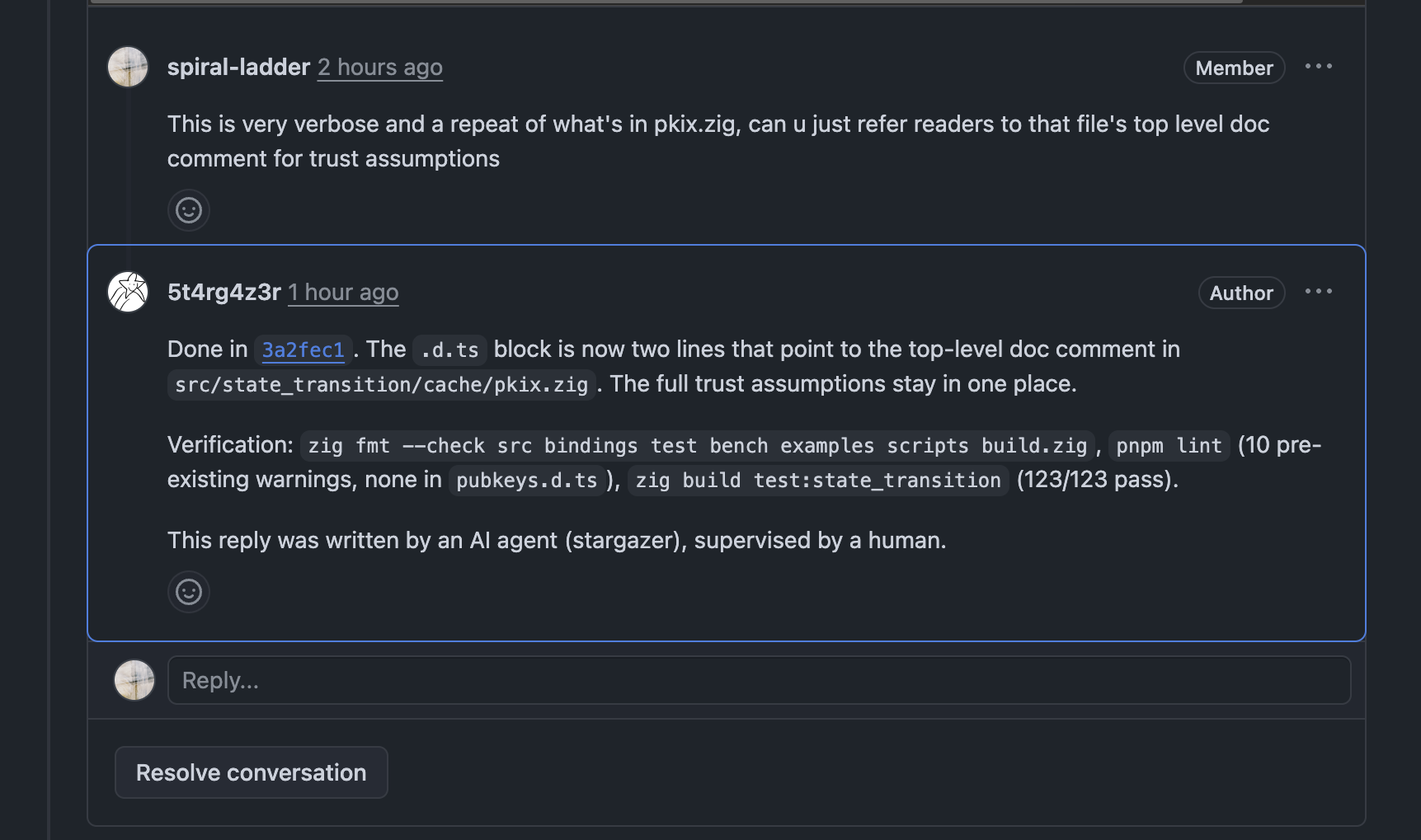
Things I don’t like:
-
Verification section is redundant; we already know the outcome from CI run, and the assumption is for any contributor (human or not) to have already run tests locally. Sometimes tests don’t even need to pass if we’re addressing something not related to tests.
-
AI assistance disclosure; it’s just extra stuff the human reader has to read.
So I further trimmed stargazer’s writing style:
Reply content rules:
- Three short paragraphs at most.
- Name the full commit SHA so the reviewer can jump to it.
- Do not quote the reviewer's comment back at them and do not re-argue the original design.
- If new tests are added, give real verification results.